

MATERIALS.METHODS.VALIDATION.
Computational engineering is our digital foundation. We’re connecting parametric design and checked geometry with materials development and planned physical evaluation, while building towards a more intelligent design-to-product workflow.
EXPLORE THE EVIDENCE ↗WHAT THE
EVIDENCE
shows.
Published evidence informs how we develop and test D03.
- WHAT WE KNOW
- Published studies document concussion incidence, wearing barriers and the limits of tested padded headgear.
- THE ENGINEERING QUESTION
- Our central question is how a soft protective architecture performs under mechanical loading while meeting player and regulatory requirements.
- PLANNED TEST PROGRAMME
- The planned programme covers material response, repeated loading, complete-headguard mechanics, fit, player experience and regulatory requirements.
Match exposure and practical use.
A 2026 synthesis reported 10.98 concussions per 1,000 rugby-union match-player-hours and 0.34 per 1,000 training-player-hours. The pooled estimates combine studies with different populations, rugby-union formats and clinical or protocol-based assessment methods. Match-player-hours sum exposure across players; the rate is not an individual player’s probability. De Sousa-De Sousa et al. (2026)
A UK online survey recorded regular match headgear use in 195 of 545 respondents (36%) in March–June 2016. Respondents in this self-selected UK sample described discomfort, heat and restricted senses as barriers. Barnes et al. (2017)
Three findings behind the design brief.
The RFU’s 2018–19 professional surveillance report states that 21% of players sustained at least one match concussion. The programme monitored 763 registered squad players across all 12 Premiership clubs, including first-team academy players. The report does not give the unique-player count behind the 21% statement. Its 166 match concussions are injury events; its 20.4 per 1,000 match hours is an incidence rate. RFU season report / 2018–19, pp. xii and xxxii
In Barnes and colleagues’ UK survey, 124 of 185 previous but non-regular headgear wearers (67%, rounded) said they had tried headgear but did not like wearing it. This is a subgroup of the 545-person survey conducted in March–June 2016, not all respondents or all rugby players. Barnes et al. (2017), Headgear use and injury
Knight and colleagues surveyed parents and guardians of under-16 and under-18 female rugby players in England in March–August 2024. Among 285 eligible respondents, Table 2 reports 76% selecting “Never” for their child’s scrum-cap use. The study contacted 1,062 parents/guardians and reports a 27% response rate; most respondents’ children played at regional level. These are parent/guardian reports in a selected sample, rather than direct observation or a national wearing rate. This finding does not establish the reasons for non-use. Knight et al. (2026), Table 2
World Rugby’s 2026–31 Strategic Plan reports more than 2.2 million women and girls playing worldwide. The figure covers participation across the sport, including non-contact formats.
Mechanical performance and injury outcomes
Laboratory testing measures how protective structures respond to impacts, including linear and rotational head acceleration. Clinical research is required to establish whether mechanical differences translate into changes in diagnosed injury rates. Concussion can follow forces transmitted from head, neck or body contact. Amsterdam concussion consensus (2023)
Instrumented-mouthguard research in elite men’s and women’s rugby examines both linear and angular head acceleration. Thresholds, event definitions and populations affect interpretation; acceleration alone does not diagnose concussion. Instrumented mouthguard tackle study (2024)
Concussion in professional training.
In a study of men’s English Premiership training across the 2016/17–2023/24 seasons, the reported concussion incidence was 0.23 per 1,000 training player-hours (95% confidence interval 0.22–0.29). The mean time absent per training concussion was 18 days (95% confidence interval 15–21). These are professional men’s training data, not match, youth or women’s rates. Training concussion surveillance (2026)
Clinical studies of padded headgear.
A youth rugby trial did not demonstrate concussion reduction with the tested padded headgear; low wearing adherence limits interpretation. Youth rugby headgear trial (2009) A later professional men’s cohort also found no protective association for suspected head injury assessments. Its observational design cannot establish causation, and suspected assessments are not all confirmed concussions. Professional men’s headgear cohort (2025/26)
Controlled headform testing
Stitt and colleagues tested selected soft headgear on a Hybrid III headform and neck, varying impact speed, orientation and surface angle. They measured linear and rotational acceleration, finding differences between the tested products. The measured differences concern those products under the specified laboratory conditions. Stitt et al. (2022)
Repeated exposure and long-term health.
Repetitive head impacts warrant investigation. The Amsterdam consensus distinguishes postmortem CTE neuropathology from clinical diagnoses and identifies uncertainty around prevalence, causation and individual risk. It does not support deriving CTE risk from a single impact measure. Amsterdam concussion consensus (2023)
D03 has not demonstrated prevention of concussion, brain injury or CTE. Product development and safety information ↗
GEOMETRY
UNDER
investigation.
The headguard architecture is designed as one continuous structure with a protective foundation and expressive SPM. The external specimen provides a reference for cellular openings, struts and transitions.
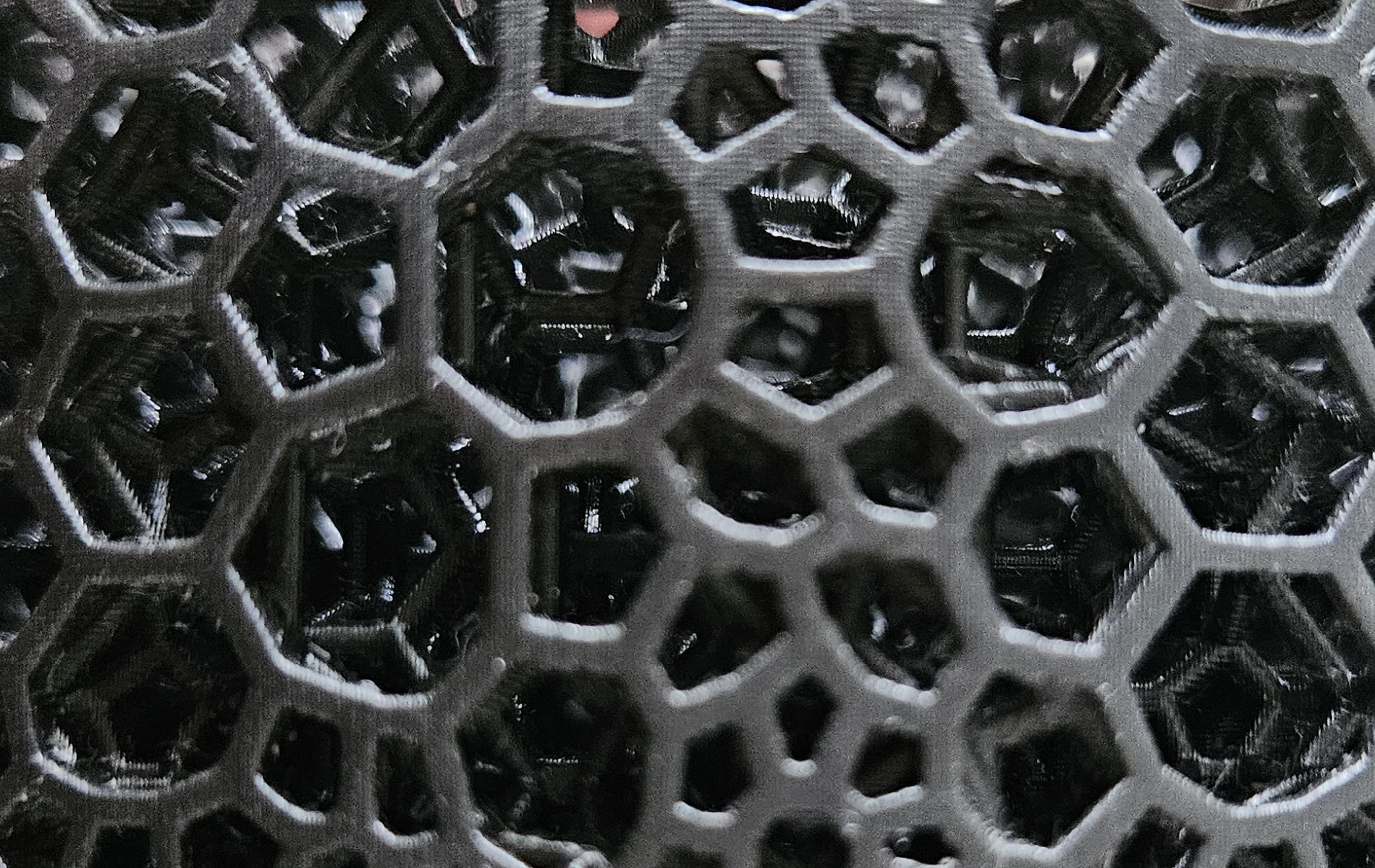
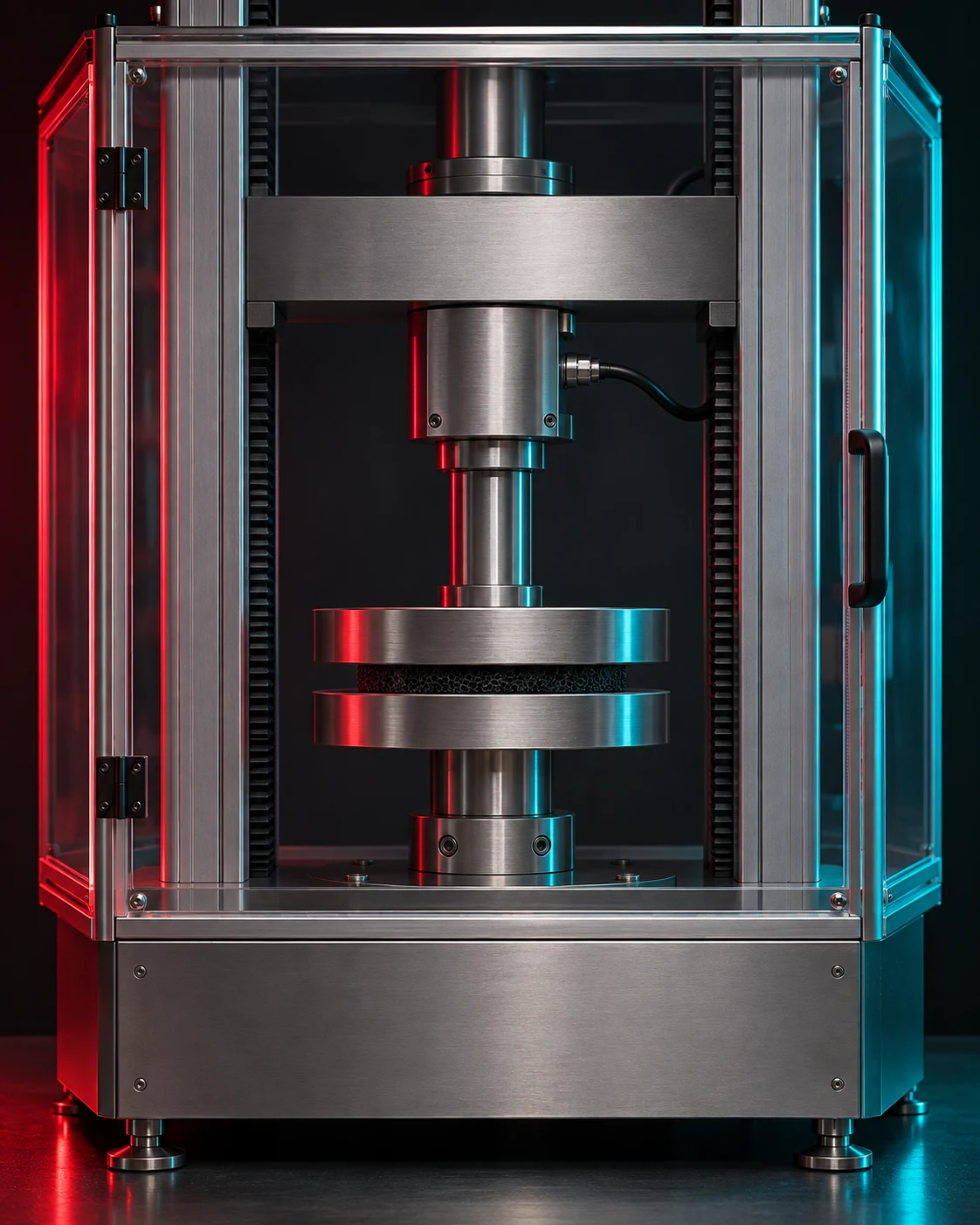
Geometry, thickness, mass and material behaviour guide our design choices. Physical tests will measure how the foundation, SPM and their connections respond together under load.
MEASURE.
ITERATE.
refine.
Design, build, measure and improve: how we develop D03.
MATERIAL.
GEOMETRY.
THE
whole
SYSTEM.
RESEARCH PROGRAMME / PLANNED PHYSICAL TESTING
Comparing the foundation with integrated SPM.
Planned foundation-only specimens will provide the reference.
Planned integrated specimens will include SPM and its transitions to test their effect on mechanical response.
Tests will match foundation geometry, material and setup wherever feasible and record mass or thickness differences. The protocol will define impact locations, angles, speeds and comparison criteria before testing.
Planned measures include linear and angular headform acceleration, deformation and load distribution under normal and oblique impacts. Repeated-impact tests will assess recovery and changes in response. Measurements will be tied to defined test conditions.
Whole-headguard evaluation.
The programme moves from specimen tests of material behaviour, consistency and durability to whole-headguard evaluation of fit, retention, comfort, ventilation, hearing, vision, snagging and player contact. Player experience and match-use eligibility have distinct evaluation requirements.
DISCUSS THE RESEARCH PROGRAMME↗FROM
DESIGN
TO
EVIDENCE.
Our development work connects digital design, materials, physical testing and player experience.
Player needs and design requirements
The design brief includes mechanical objectives, fit, comfort, retention, hearing, vision and player contact.
Digital design / progress so far
Our parametric engineering foundation uses automated CAD generation to define and check a specific headguard configuration against geometric constraints. That is documented digital progress. Next steps include manufacture, material evaluation and performance testing of the complete headguard.
TrueContourAI supports our research into digital head capture. We are investigating how head-shape data could inform anatomical design, protective-zone definition and future fit evaluation. Scan accuracy and integration into the headguard CAD workflow remain to be validated.
EXPLORE TRUECONTOURAI ↗Proposed workflow: head capture → anatomical design → manufacturing development → physical evaluation.
Materials and samples / in development
Current materials research focuses on candidate soft materials, cellular geometry and repeatable specimens for physical comparison.
Mechanical testing / planned
Compare the foundation with integrated SPM variants under defined loading conditions, measuring headform response, deformation and repeated-load recovery.
Whole product and players / planned
Evaluate fit, mass, retention, comfort, ventilation, hearing, vision, snagging and opponent contact. Player research will examine practical use and acceptance.
HEAR ABOUT FUTURE HEADGUARD RESEARCH ↗Manufacturing and match-use requirements
Confirm the equipment pathway and qualify the manufacturing process. D03 is not approved for match use or available to buy.
DESIGN.
SIMULATE.
MANUFACTURE.
TEST.
Learn.
OUR FUTURE ENGINEERING ARCHITECTURE
Our ambition is a closed-loop engineering system: AI-enabled design exploration, physical simulation, manufacturing feedback and experimental data informing each successive design.
Generative engineering and inverse design.
Future generative design tools could explore candidate structures within defined constraints. Inverse design would start with targets such as fit, mass, deformation and mechanical response, then seek geometries that meet them. The value we aim for is more efficient exploration of difficult engineering trade-offs.
Digital twins grounded in evidence.
We envision computational representations connecting anatomical geometry, product configuration and measured behaviour. Developing useful digital twins will require physical data and model validation beyond the digital geometry we have today.
Learning from physical results.
Materials tests, manufacturing variation and complete-headguard results could feed back into future design and simulation tools. Building that connection is our closed-loop optimisation ambition; physical validation is the next essential foundation.
THE
CURRENT
12mm
ENVELOPE.
World Rugby’s standard headgear specification limits overall uncompressed thickness, including fabric on both sides, to 12 mm. Its intended protective scope is cuts and abrasions; compliance does not establish protection against concussion. World Rugby Headgear Performance Specification World Rugby Regulation 12
OUR RESEARCH AMBITIONWe intend to investigate both compliant designs and thicker protective structures. If robust independent evidence demonstrates a meaningful benefit to players without unacceptable risks, we would seek engagement with World Rugby on an appropriate assessment pathway and, where justified, changes to the requirements.
EVIDENCE BEFORE APPROVALD03 remains a development concept. It has not demonstrated clinical benefit or secured approval for match use. World Rugby’s separate Law 4 headgear trial requires independent assessment and claim validation. Its published exceptions do not expressly waive thickness, so we do not assume that it provides a route for a design above 12 mm. World Rugby Law 4 Headgear Trial
READ
THE
evidence.
The published research informing our design and testing.
- 01Amsterdam concussion consensus (2023)
Patricios et al. British Journal of Sports Medicine. DOI: 10.1136/bjsports-2023-106898. Evidence-informed consensus; uncertainty remains around long-term outcomes.
- 02Training concussion surveillance (2026)
Hudson et al. Training-related concussions in men’s English Premiership Rugby Union. DOI: 10.1136/bjsports-2026-111653. Seasons 2016/17–2023/24; professional men in England; training exposure, not match exposure.
- 03Instrumented mouthguard tackle study (2024)
Instrumented mouthguards in elite-level men’s and women’s rugby union: characterising tackle-based head acceleration events. DOI: 10.1136/bmjsem-2024-002013. Sensor and video observations; head acceleration is not a concussion diagnosis.
- 04Professional men’s headgear cohort (2025/26)
Brown et al. European Journal of Sport Science. DOI: 10.1002/ejsc.70105. Observational study of 2018–2019 Super Rugby; suspected head injury assessments were the outcome, not confirmed concussion in every case.
- 05Youth rugby headgear trial (2009)
McIntosh et al. Does padded headgear prevent head injury in rugby union football? Medicine & Science in Sports & Exercise. DOI: 10.1249/MSS.0b013e3181864bee. Cluster-randomised youth rugby trial; results concern the tested headgear. Low adherence limits interpretation; no demonstrated concussion reduction in the tested headgear.
- 06World Rugby Headgear Performance Specification
Official headgear specification. Thickness, coverage, hardness, retention, vision and other requirements apply; equipment compliance is distinct from clinical efficacy.
- 07World Rugby Law 4 Headgear Trial
Official application, independent assessment and claim-validation pathway; participation and suitability are not automatic.
- 08World Rugby Regulation 12
Official provisions for players’ clothing and approved equipment.
- 09Concussion incidence synthesis (2026)
De Sousa-De Sousa et al. DOI: 10.1136/bjsports-2025-110774. Mixed rugby-union/rugby-league review; pooled rugby-union match and training estimates use distinct exposure denominators.
- 10UK player headgear survey (2017)
Barnes et al. DOI: 10.1136/bmjsem-2017-000255. Online self-selected UK sample, 2016 responses; historical wearing attitudes, not global adoption.
- 11Soft-shell headgear laboratory study (2022)
Stitt et al. DOI: 10.1007/s10439-022-02912-5. Selected products and controlled headform conditions, not D03 or clinical efficacy evidence.
- 12Professional rugby injury surveillance / 2018–19
England Professional Rugby Injury Surveillance Project season report, pp. xii and xxxii; Table S8. Reported seasonal player proportion is 21%; 20.4 per 1,000 match hours is a separate incidence measure.
- 13Parents’ and guardians’ survey / 2026
Knight et al. DOI: 10.1136/bmjsem-2026-003332. U16/U18 female rugby in England; March–August 2024 survey. Parent/guardian reports, 285 eligible respondents, 27% response rate; Table 2 gives 76% “Never” for scrum-cap use.